Capitol-izing on an Opportunity
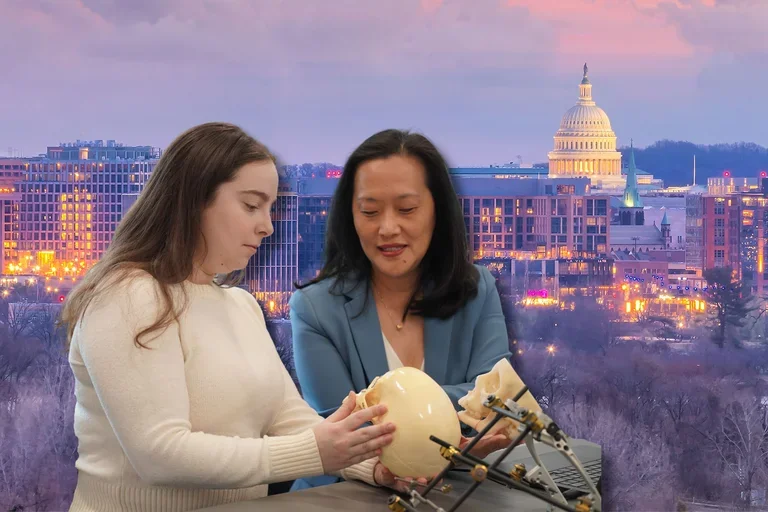
Amy Banks, D.D.S. ’28, is spending this academic year conducting intensive research at the NIH, mentored by a School of Dentistry alumnus
This story appears in the UCLA School of Dentistry's 2026 magazine
Read all content or
View interactive flipbook
Towards the end of her first year at the UCLA School of Dentistry, Amy Banks, D.D.S. ’28, attended a presentation by Janice Lee, D.D.S. ’94, M.D., M.S. ’98, clinical director and chief of the Craniofacial Anomalies and Regeneration Section at the National Institute of Dental and Craniofacial Research (NIDCR).
Banks was already interested in the specialty, having worked for six years as an assistant to an oral and maxillofacial surgeon before starting dental school in 2023.
In addition to describing her research, Dr. Lee detailed her career path and the value of a National Institutes of Health (NIH) fellowship she completed after residency and medical school at Harvard. Dr. Lee’s mention of another NIH initiative prompted Banks to take notice.
The Medical Research Scholars Program (MRSP) immerses future medical, dental, and veterinary clinician-scientists in an intensive year on the NIH campus in Bethesda, Maryland, where they conduct basic, clinical, or translational research while receiving professional development and mentorship.
“I was attracted to the opportunity to solely focus on research, as I hope to pursue a career in academia,” said Banks, a native of Chatsworth, California, who earned her B.S. in Biological Sciences at UC Santa Barbara.
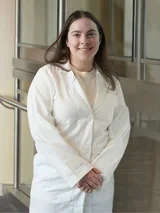
She is one of four dental students among the 30-member 2025-26 cohort, selected from hundreds of applicants across U.S. medical, dental, and veterinary schools. When MRSP commenced last June, participants were invited to explore opportunities with primary investigators across the NIH ecosystem.
Banks gravitated toward the mentorship of Dr. Lee, whose lab focuses on craniofacial and oral anomalies and disorders that impact human facial development. For Dr. Lee, the opportunity to pay it forward and welcome a fellow Dental Bruin into her lab is especially meaningful.
“I had incredible mentors who encouraged me to be curious, be creative, look for answers, and ask questions – and I think that’s what research is all about,” Dr. Lee said.
She cited Drs. Charles Bertolami and Earl Freymiller, former chairs of the Section of Oral and Maxillofacial Surgery, and George Bernard, ’63, Ph.D. ’67, her master’s thesis mentor, as major influences.
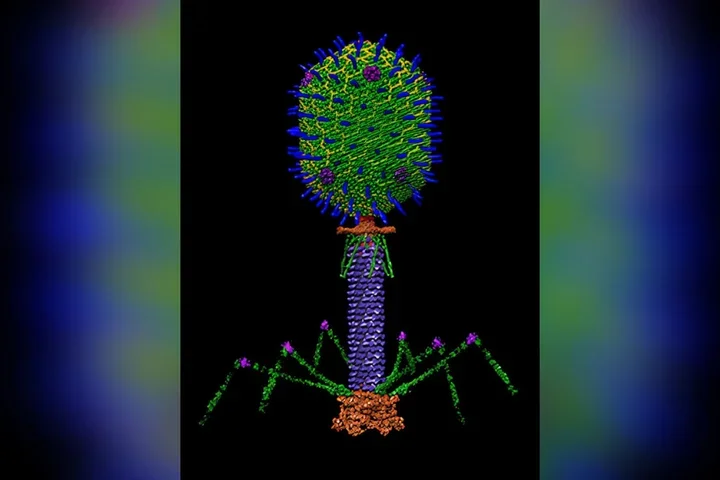
In 2025, Dr. Lee strengthened her connection to her alma mater by signing on as an MPI to the Human Virome Characterization Center at UCLA. The center is funded over five years by the largest NIH grant in the School of Dentistry’s history and is led by its Associate Dean of Research, Dr. Yvonne Hernandez-Kapila.
As eager as she was to participate, Banks had reservations about pausing dental school for 12 months and moving across the country. However, everyone she spoke with encouraged her, assuring her the gap would not disrupt her schooling.
Dean Paul H. Krebsbach, in particular, urged Banks to apply, drawing on his own experience as an NIH senior staff fellow from 1993 to 1996.
“Being immersed in the NIH environment gave me the space to mature scientifically, build confidence, and develop strong ideas and networks without the competing demands of teaching and administration,” Dean Krebsbach said. “Those three years solidified my identity as a scientist and positioned me for the best possible academic career. It truly made all the difference in where I ended up professionally.”
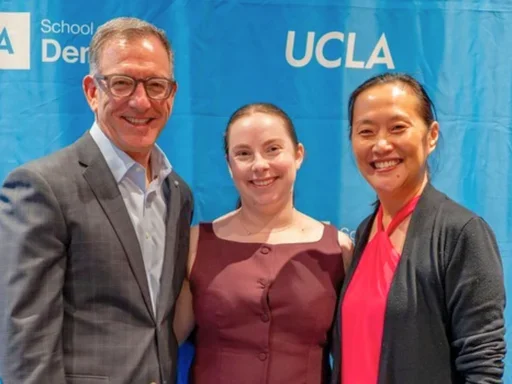
“I encouraged Amy to apply because even if she doesn’t ultimately pursue a research career, the experience will be life-changing,” he added. “She’s surrounded by incredibly bright, like-minded young clinician-scientists. That foundational knowledge makes a dental practitioner aware of how everything in clinical practice is grounded in science.”
Banks is working on several projects at the NIH and spends around 40 hours per week immersed in the lab environment. One involves analyzing the craniofacial features of patients with Loeys-Dietz syndrome (LDS), a rare connective tissue disorder involving enlargement of the aortic root, among other symptoms.
“We’re looking at whether there is a correlation between the severity of the craniofacial manifestations and their cardiovascular phenotypes,” she said. “If so, we may be able to prevent cardiovascular morbidities among younger patients who present with these craniofacial features but haven’t yet shown cardiovascular symptoms.”
She is also involved in a project assessing the feasibility of using ultrasound to image the temporomandibular joint (TMJ).
“The current gold standard, MRI, is more costly, complicated, and less accessible, as it requires visiting an imaging center,” Banks said. “Dr. Lee wanted to investigate an imaging modality available at a typical dentist’s office.”
“Ultrasound gives us a dynamic image, allowing us to look at the function of the joint as it’s moving,” Dr. Lee added, in contrast to other, static imaging modalities used to examine the head and neck.
Dr. Lee chooses to mentor because her trainees inspire her to evolve and innovate.
“It’s a two-way exchange, because I learn so much from these folks and their creativity helps me jumpstart ideas,” she said, noting that the majority of MRSP participants remain in research-related careers.
Banks also enjoys the interdisciplinary collaboration at NIH. She has worked with researchers at the National Institute of Allergy and Infectious Diseases (NIAID) regarding LDS patients, as well as with statisticians and engineers.
The MRSP provides participants with opportunities beyond research. They take part in journal clubs and attend monthly lectures given by clinical directors from different institutes.
NIH Director Dr. Jay Bhattacharya spoke to the group about his career path, balancing research and clinical practice, and transitioning to his current leadership role.
Participants also take part in clinical teaching rounds, where researchers often bring in patients or include them via videoconference.
Outside of the lab, Banks and her colleagues are enjoying Washington, D.C., exploring attractions such as the Smithsonian museums and attending a Nationals baseball game together.
“I definitely feel that I’ll return to UCLA as a better future clinician,” Banks said. “I look forward to a future immersed in opportunities that advance research and promote the importance of oral health – and how it truly reflects overall systemic health.”