
Digital Dentistry and Artificial Intelligence: From Innovation to Integration
UCLA Dentistry’s 2026-31 Strategic Plan sets a path for expanding technology across education and patient care.
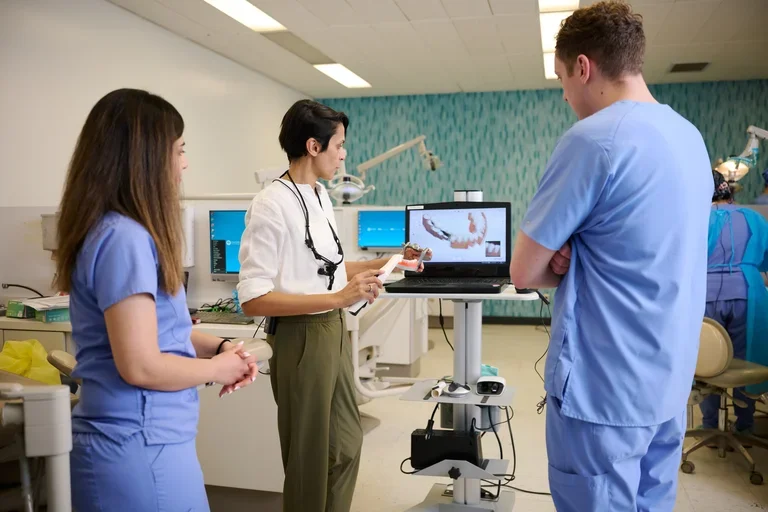
When UCLA School of Dentistry established Innovative Digital Dentistry Systems (iDDS) in 2018, the goal extended beyond acquiring the latest technology. The School envisioned a program that could transform how dentistry is taught and practiced by connecting digital tools with education, research, and patient care.
Eight years later, with the launch of a new organizational strategic plan, that transformation is entering a new phase to further embed digital dentistry into clinical practice and apply artificial intelligence (AI) in diagnosis, planning, and operational workflows.
The School’s 2026-31 Strategic Plan makes expansion of iDDS a key component of its first strategic imperative, Excellence in Education and Patient-Centered Collaborative Care. The plan calls for greater use of digital simulation, intraoral scanning, and same-day 3D printing and milling, along with development of a digital dentistry preceptorship for practicing dentists.
“Our goal is not simply to adopt new technology, but to ensure that innovation meaningfully advances how we educate future dentists and care for our patients,” said Dean and Professor Dr. Paul H. Krebsbach. “The expansion of iDDS reflects that commitment … bringing digital tools and AI into the learning and clinical environments where they can have the greatest impact.”
For iDDS, that future increasingly means moving digital technology from specialized applications into routine learning and clinical workflows.
UCLA dental students first encounter digital technology with simulation and preclinical skill development. In the clinics, intraoral scanners can support treatment planning, smile design, and indirect restorations, while iDDS 3D printing and milling capabilities can enable certain definitive restorations to be delivered in a single visit.
“The next step is making these workflows part of the everyday experience for our students and patients,” said Dr. Shahed Al Khalifah, iDDS co-director and associate clinical professor of Restorative Dentistry. “We want students to understand the entire digital process – from scanning and design through fabrication and delivery – and how to use it thoughtfully to improve patient care.”
That expansion will be measurable. The strategic plan establishes a benchmark of more than 20% of completed restorative and prosthodontic cases utilizing digital dentistry tools, including intraoral scanning, digital design, milled or printed restorations, and same-day delivery.
Supporting indicators will look more closely at where adoption is occurring, including digital components in preclinical exercises, scanner utilization, same-day restorations, and progress toward establishing a digital dentistry preceptorship.
The emphasis on measurement reflects a larger principle: New technology should be evaluated, not adopted simply because it is new.
“Digital dentistry and AI are evolving extremely quickly, but our responsibility as educators is to determine where these technologies genuinely make care and education better,” said Dr. Denny S. Chao, iDDS co-director and associate clinical professor. “We want our students exposed to emerging tools, but we also want them to understand the evidence behind when and how those tools should be used.”
“Digital dentistry and AI are evolving extremely quickly, but our responsibility as educators is to determine where these technologies genuinely make care and education better." – Dr. Denny S. Chao
That philosophy is becoming increasingly important as digital dentistry converges with artificial intelligence. The strategic plan calls for at least 90% of faculty, staff, and students to complete AI training and at least 10 AI evaluation projects to be launched or active annually. Areas for evaluation include clinical decision support for diagnosis, treatment planning, and prognostics, image-based skill assessment, and the delivery of education.
Associate Dean for Strategic Initiatives and Operations Dr. Sunil Kapila – who chaired the Strategic Planning Committee and oversees its implementation and outcomes – added that the strategic imperatives are truly forward-looking in their scope and intent.
“Incorporating technology in clinical and academic endeavors will better prepare our students for the rapidly evolving practice and knowledge assimilation environment,” he said.
Together, these initiatives represent a shift from innovation to integration; making technology an increasingly routine part of how UCLA dentists learn, teach, and care for patients.
They also advance the School’s broader strategic direction. UCLA Dentistry’s 2026-31 plan connects measurable priorities and tactics to its mission and vision, with technology integration positioned within the imperative focused on excellence in education and patient-centered collaborative care.
For iDDS, the ultimate measure of progress will extend beyond scanners, printers, mills, or software. It will be whether technology reaches the patient chair and makes education and care better when it gets there.